

How to Recognize and Avoid Online Casino Fraud
Fraud Prevention in Online Casino starts before the first deposit. The goal is simple: Verify who receives your money, recognize fake licenses and payment traps, protect account credentials, and know when a withdrawal problem has crossed from routine checking into fraud.
Where Online Casino Fraud Begins
Casino fraud rarely announces itself with an obviously fake page. The more effective scams borrow familiar logos, polished game graphics, payment icons, promotions, and even customer-support scripts.
The danger usually appears at three points: Registration, deposit, and withdrawal. Catching trouble at the first stage is far easier than trying to recover PHP after a transfer has already been completed.
Fake Domains and Copied Casino Identities
A copied casino can look convincing enough to pass a quick glance. Fraudsters may register a domain differing by one letter, use another extension, clone a login page, or distribute a special “VIP” link through Messenger or Telegram.
The appearance proves very little.
PAGCOR has previously identified illegal gaming websites displaying its logo and fabricated license certificates. It has also warned about a counterfeit website impersonating PAGCOR itself.
Before entering a password or sending money, inspect:
- The exact spelling of the domain.
- Unexpected redirects after clicking Login or Deposit.
- Whether the domain matches the operator’s verified record.
- Whether support contacts suddenly move to another website or private account.
- Any request to download an unfamiliar APK from a message rather than an established official channel.
Offers Designed to Trigger Fast Deposits
The strongest scam offers often create urgency instead of simply promising a bonus.
A useful real example came from PAGCOR in May 2025. The regulator warned about agreements that claimed participants could potentially earn PHP 50,000 after paying an initial PHP 3,000. PAGCOR said the offshore license cited in those agreements was fake.
That pattern is more important than the exact figures: Pay first, receive a much larger amount later, and do not spend too much time checking.
A promotion becomes dangerous when the pressure to deposit is stronger than the information explaining how the money can actually be withdrawn.
Verify the Casino Before Sending PHP
Good Fraud Prevention in Online Casino is mostly front-loaded. Spend two minutes verifying an operator before making a PHP 5,000 deposit and you may avoid hours of chats, screenshots, disputes, and recovery attempts later.

Verify the Casino Before Sending PHP
Check the Exact Domain and License Record
Do not search only for the casino name. Verify the domain you are actually using.
PAGCOR maintains information on registered gaming brands and domain names, while PAGCOR Guarantee was introduced so users can check whether an internet gaming provider is recognized under its oversight.
A practical verification routine is:
- Copy the exact casino URL.
- Check it against official regulatory records rather than a certificate supplied by an agent.
- Compare the spelling character by character.
- Check again if a deposit or login button redirects to another domain.
- Stop if the licensing claim and registered domain do not match.
A Logo Is Not a License
A PAGCOR badge in the footer is an image. A license certificate can also be copied, edited, or fabricated.
Independent verification matters because PAGCOR has specifically reported fake gaming sites using both its logo and counterfeit certificates.
The regulator’s record should confirm the casino—not the casino’s own artwork confirming itself.
Treat Offshore-License Claims Carefully
There is another easy filter in the Philippines. PAGCOR states that all Internet Gaming Licensees and Authorized Providers under its offshore gaming framework were cancelled effective December 15, 2024. It warns that companies claiming to possess valid PAGCOR offshore or internet gaming licenses under that framework are unauthorized.
That does not mean every reference to online gaming is automatically fraudulent. It means the exact type of license being claimed deserves attention. Terms such as “PAGCOR offshore license” should never be accepted at face value.
Payment Fraud Warning Signs
Fraud becomes much more expensive once money leaves your wallet.
A payment route can legitimately change because operators use different processors, but several warning signs appearing together should stop a deposit immediately.
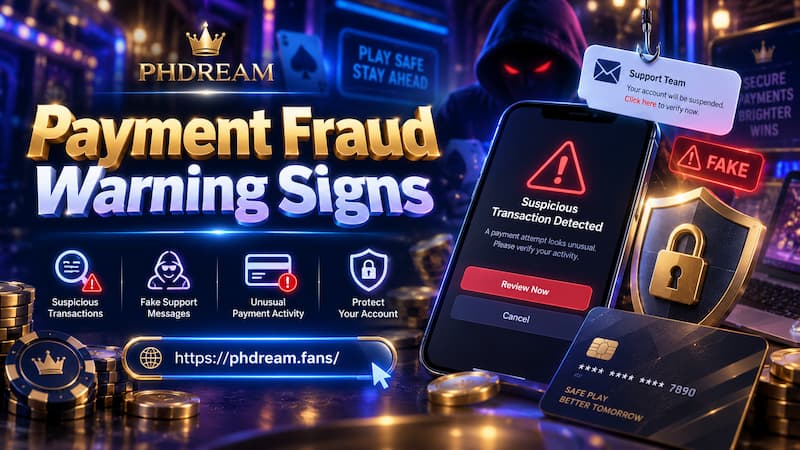
Payment Fraud Warning Signs
Changing Personal Payment Accounts
Be cautious when:
- A different GCash number is supplied every time.
- The recipient cannot be connected to the stated payment process.
- An agent insists on a manual transfer through private chat.
- The first transfer is called “unverified” and another payment is demanded.
- A second deposit is required to activate the first.
- You are told that waiting a few minutes will cancel a special rate or reward.
One unusual recipient is not proof of fraud. The stronger signal is inconsistency combined with pressure and poor documentation.
Save the recipient name, number, amount, timestamp, and reference ID for every PHP transaction.
OTP, MPIN and Phishing Requests
An OTP is not a customer-service verification code. It authorizes access or activity connected to your financial account.
GCash says it will never ask for an MPIN or OTP and will not send login links through SMS or email. It also warns about fake social-media support pages.
Never give casino support or an agent:
- Your GCash MPIN.
- An OTP received by SMS.
- Email or wallet passwords.
- Remote control of your phone.
- Screenshots containing information that could authorize account access.
A legitimate payment dispute can be investigated using transaction information. Nobody needs control of your wallet to confirm that PHP was sent.
Withdrawal Delay or Fraud?
A delayed withdrawal is frustrating, but delay alone does not prove fraud. Casinos may perform identity checks, review account ownership, verify payment history, or apply previously disclosed bonus conditions.
The situation changes when new financial demands appear after the withdrawal request.
Normal Verification vs Invented Fees
Pay close attention if support suddenly asks for:
- A “release fee” before winnings can be transferred.
- A tax paid directly to an agent.
- Another deposit to unlock the existing balance.
- A security payment that will supposedly be refunded afterward.
- New turnover requirements not shown when the promotion was accepted.
- Repeated payments because previous verification supposedly failed.
If PHP 20,000 is already displayed as withdrawable and someone demands another PHP 5,000 to release it, do not assume the additional payment will solve the problem. Verify the rule independently first.
Preserve Evidence Before Paying Again
When a dispute begins, stop concentrating only on the support chat. Build a clean record.
Keep copies of:
- Deposit references.
- Withdrawal request IDs.
- Balance screenshots.
- Bonus conditions.
- Account verification messages.
- Dates and PHP amounts.
- Support conversations.
- The domain used for login and payment.
If terms change later, the earlier screenshots become much more useful than trying to reconstruct the conversation from memory.
Bonus Terms Can Expose Problems Early
A difficult bonus is not necessarily fraudulent. Hidden or moving conditions are the bigger concern.
Before accepting a promotion, identify the wagering requirement, eligible games, maximum qualifying bet, expiry period, withdrawal cap, and any payment-method restriction.
Suppose a PHP 1,000 bonus requires 20x wagering. That condition can be evaluated before playing. A far worse situation is discovering after winning that the requirement has suddenly become 40x or that a previously unmentioned withdrawal limit now applies.
Save the terms before depositing. It takes seconds and gives you something concrete to compare later.
Fake Agents and Customer Support
Casino impersonation does not always require cloning an entire website. Sometimes a Facebook page, Telegram account, or Messenger profile is enough.
A fake agent may know the casino name, current promotions, payment methods, and even common support language. The conversation can feel completely normal until the agent asks for money or credentials.
Support Never Needs Wallet Control
Treat these requests as immediate danger signals:
- “Send me your OTP so I can verify the deposit.”
- “Install this remote-access app.”
- “Give me your MPIN so I can check the failed transaction.”
- “Transfer the fee to my personal account and I will release the withdrawal.”
Real support may ask for a transaction reference or screenshot with sensitive information hidden. That is very different from taking control of the financial account itself.
A Pre-Deposit Fraud Check for Phdream
The same verification standard should apply even when a casino name already feels familiar. Before depositing at Phdream, confirm that you are using the intended domain, review the payment destination, read the withdrawal rules, and keep a copy of any promotion you accept.
Before sending PHP, run this short check:
- Confirm the exact URL.
- Independently verify any regulatory claim being presented.
- Check the GCash or payment recipient before approving the transfer.
- Read the conditions affecting withdrawal.
- Use established support channels instead of unsolicited private accounts.
- Stop if someone demands additional money to release funds already owed.
That habit is far more valuable than judging security from design, advertisements, or a familiar logo.
What to Do After Suspected Casino Fraud
Once fraud is suspected, the priority changes from playing or withdrawing to limiting further exposure.
Stop Payments and Secure the Account
Do not keep depositing because someone promises the next payment will unlock everything.
If GCash credentials may have been exposed, change the MPIN and protect the account immediately. GCash specifically advises users who receive an unauthorized device-registration OTP not to share it and to change their MPIN.
Also change reused passwords on other accounts if the same password was entered on a suspicious casino login page.
Report With Evidence
Contact the relevant bank or e-money issuer quickly when a suspicious or unauthorized transaction involves the payment account. BSP’s consumer guidance says suspicious transactions should be reported immediately to the bank or e-money issuer, and its complaint process expects consumers to first raise the issue with the financial institution involved.
Give support a clean evidence package rather than scattered messages: Transaction references, recipient details, timestamps, screenshots, URLs, phone numbers, and chat records.
Fraud Prevention Starts Before the Deposit
Fraud Prevention in Online Casino is strongest when verification happens before money moves. Check the exact domain, verify licensing independently, protect OTPs and wallet credentials, read withdrawal conditions before accepting bonuses, and keep records of every PHP transaction.
The most useful rule is also the simplest: When someone asks you to send new money just to recover money that is already yours, stop and verify before sending anything else.