

How the Filipino Color Game Works
Color Game Mechanics are built around three dice, six colors, and a result that can contain one, two, or three matches. The goal here is simple: Explain how a round works, how payouts connect to each dice result, and how online versions differ from the familiar perya game.
Color Game Mechanics at a Glance
The Filipino Color Game is easy to recognize because very little stands between the bet and the result. There are usually three six-sided dice, with each face assigned one of six colors such as red, blue, green, yellow, white, and pink. A player chooses one or more colors before the betting period ends, then all three dice determine the outcome.
The important detail is that there is no single “winning color” in every round.
Suppose the dice land:
Red – Blue – Yellow
Red, blue, and yellow have each appeared once. A bet on any of those colors may qualify for the corresponding single-match payout.
Now compare that with:
Red – Red – Yellow
Red appears twice, while yellow appears once. Those two bets are settled differently because Color Game Mechanics count how many dice match the selected color.
That distinction becomes even more important with triple results such as Red–Red–Red.
The Three-Dice Setup
The standard structure uses:
- Three dice per round
- Six possible colors on each die
- One color on each face
- One or more selectable color betting areas
- A short betting period before the dice are resolved
Physical perya games and online versions share this basic idea, although their payout tables, multipliers, and special features may not be identical. Current online Color Game implementations in the Philippines still commonly use the familiar three-dice and six-color format.
From Color Selection to Dice Result
A round moves quickly, but understanding the sequence prevents a lot of confusion about what has actually been won.
Choosing a Color and Stake
Start by selecting a color and assigning a stake to it. Imagine placing ₱100 on red.
If only red is selected, the entire ₱100 depends on red appearing in the result. Choosing another color creates another wager rather than extending the original ₱100 bet.
For example:
- ₱100 on red means ₱100 is exposed.
- ₱100 on red and ₱100 on blue means ₱200 is exposed.
- ₱100 on three different colors means ₱300 is exposed.
Covering several colors can make it more likely that at least one selected color appears, but it also means more money has been placed on the board. This is why the number of winning colors and the overall result of the round are not the same thing.
Betting Closes and the Dice Resolve
Once the countdown finishes, no additional bets are accepted. Three dice are then rolled or digitally generated, depending on the game format.
Each active color bet is checked against the final three faces.
A result of Blue–Blue–Green, for instance, contains:
- Two blue matches
- One green match
- No red, yellow, white, or pink match
Settlement follows the paytable attached to that particular Color Game.
Single, Double, and Triple Color Matches
The phrase “my color hit” only tells half the story. Color Game Mechanics also measure how many times that color appears.
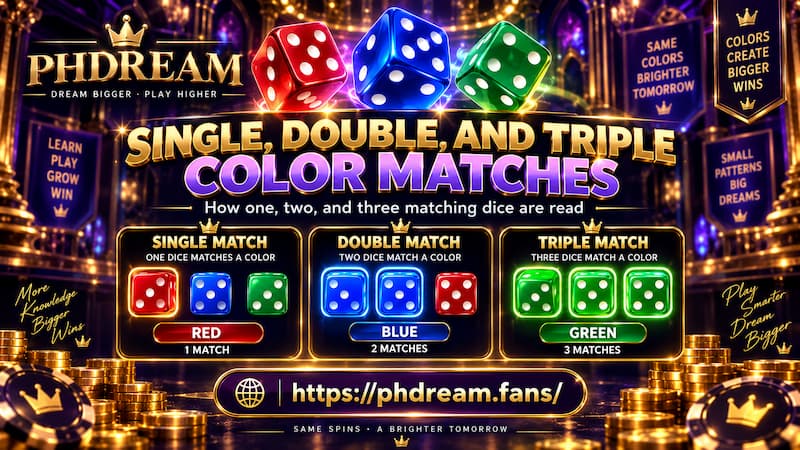
Single, Double, and Triple Color Matches
One Matching Die
Consider:
Red – Blue – White
If the bet was on red, there is one red match.
In the traditional simple payout model, one match is commonly associated with a 1:1 result. A ₱100 wager would therefore generate ₱100 in profit if the table uses that structure, with the original stake returned separately.
Two Matching Dice
Now take:
Red – Red – White
Red appears twice. This is a double result for red.
Traditional tables often increase the base payout when the same selected color lands on two dice. Online variants can go further by attaching special multipliers to doubles.
Three Matching Dice
Red – Red – Red is a triple.
Triple results are naturally much less common because all three dice must land on the same chosen color. They may also qualify for enhanced payouts or special features in online versions.
Do not assume that every Color Game pays singles, doubles, and triples exactly the same way. The game screen or paytable should be treated as the settlement rule for that version.
The Math Behind One Selected Color
Three dice with six possible faces each produce:
6 × 6 × 6 = 216 possible ordered outcomes.
For one particular color, such as red, those 216 outcomes can be separated cleanly.
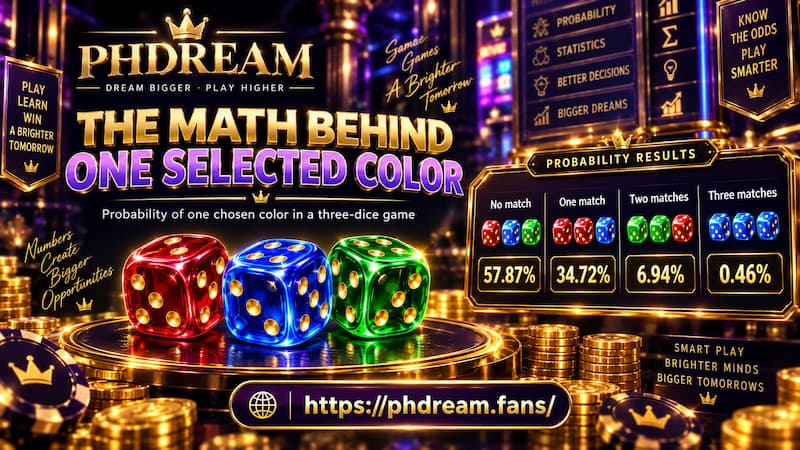
The Math Behind One Selected Color
Probability of Each Match Count
For red:
- No red appears: 125 out of 216 outcomes, or about 57.87%
- Exactly one red appears: 75 out of 216, or about 34.72%
- Exactly two reds appear: 15 out of 216, or about 6.94%
- Three reds appear: 1 out of 216, or about 0.46%
This means red appears at least once in:
91 out of 216 outcomes, or about 42.13%.
The same calculation applies to any other color when each die has one face for each of the six colors.
A Hit Rate Is Not a Profit Rate
The 42.13% figure is useful, but it is easy to misread.
It tells us how often one chosen color appears at least once under the standard three-dice model. It does not mean 42.13% of rounds automatically produce an overall profit.
Payout size still matters.
If a game pays differently for singles, doubles, triples, or bonus multipliers, the value of those outcomes changes even though the underlying dice combinations remain the same.
JILI Color Game at Phdream
The JILI version available through Phdream keeps the central color-and-dice idea but adds features that make it different from the simplest perya payout board.
JILI officially describes Color Game as a three-dice game where matching the winning color produces a reward. More importantly, DOUBLE and TRIPLE results can receive additional multipliers.
Double and Triple Multipliers
A double means two dice land on the same color. A triple means all three share the same color.
Those results already have different probabilities from a normal single match, but JILI can also attach extra rewards to them. This means the final settlement cannot always be calculated simply by remembering an old 1x, 2x, 3x perya rule.
The correct habit is to check:
- The displayed bet odds for a normal match
- The payout attached to a double
- The payout attached to a triple
- Any multiplier currently attached to that result
- Whether the displayed figure means profit only or total return
Small differences in notation can make two payout screens look more similar than they actually are.
Three Green Dice and the Jackpot Feature
Green has an additional role in JILI Color Game.
According to JILI’s official game information, three green dice can trigger a special bonus and the Super Jackpot, with special rewards reaching up to 5000x in the game’s stated feature description.
That is not simply an ordinary green triple with a standard payout attached. It belongs to JILI’s additional reward system, so it should be read according to the current in-game rules rather than treated as a universal Color Game rule.
Perya Rules and Online Rules Are Not Identical
Anyone familiar with a fiesta Color Game will recognize the online version immediately: Colors are selected, three dice decide the result, and matching colors determine winning positions.
The difference lies in settlement and presentation.
Traditional Perya Format
A physical game usually centers on:
- A visible color board
- Physical dice
- Manual bet placement
- Simple match-based payouts
- A game operator controlling each round
Online Color Game
Digital versions may add:
- Automatic bet settlement
- Countdown timers
- Result history
- Double and triple bonuses
- Random multipliers
- Jackpot mechanics
- Configurable betting limits
The core remains recognizable, but the extra mechanics are enough to make memorizing rules from one version unreliable when moving to another.
Reading Recent Color Results
Online Color Games often display previous outcomes because three dice create an easy visual history. You may see red appearing repeatedly, several rounds without green, or two triples landing unusually close together.
Those records describe previous rounds. They do not alter the mathematical probability of the next independent dice roll.
A sequence such as:
Red → Red → Blue → Red → Red
can look like a red streak, but it does not force blue, green, or any other color to appear next.
Each fresh roll still begins with the same underlying dice possibilities if the dice are independent. This is also why “hot color” and “cold color” observations should not be confused with a mechanical advantage.
What a Result History Is Good For
A history panel can still be useful for checking:
- Recently completed rounds
- Color frequency over a displayed period
- Double and triple results
- Whether a result was recorded correctly
- The pace and structure of previous rounds
It is a record, not a prediction engine.
Check the Paytable Before the First Bet
Color Game Mechanics are simple enough to learn in a few rounds, but payout details deserve more attention than the colors themselves.
Before placing a wager, check:
- The minimum and maximum PHP stake.
- The six available color positions.
- The payout for one matching die.
- The settlement for two and three matches.
- Any DOUBLE or TRIPLE multipliers.
- Jackpot qualification rules.
- Whether quoted odds show profit or total return.
- The countdown and round-cancellation rules.
Three dice and six colors make the game visually simple. Underneath that simple board, however, match frequency, total stake, payout notation, and special multipliers all affect how a result should be read. Once those parts are clear, a Color Game round stops looking like a blur of colors and becomes a straightforward piece of probability and settlement logic.
- Read more: Rummy card game